PSAgA training: Working safely at height | Rentit
What does PSAgA actually mean?
PSAgA stands for ‘personal protective equipment against falls from a height’. This includes, for example, safety harnesses, lanyards, fall arresters and anchor points. Their purpose is to prevent you from falling unchecked in the event of a fall, or to safely arrest the fall. Important: PSAgA is always the last link in the chain. Technical solutions such as guardrails, scaffolding or safety nets come first.
Who needs training in fall protection systems?
Anyone who works in areas where there is a risk of falling: on roofs, on scaffolding, in high-bay warehouses or on lifting platforms. This applies to roofers and tinsmiths just as much as to building services engineers, signfitters or maintenance staff. The employer is responsible for ensuring that their staff are trained. So, if you have a team that regularly works at height, it’s worth taking a look at the course calendar.
What will you learn on the course?
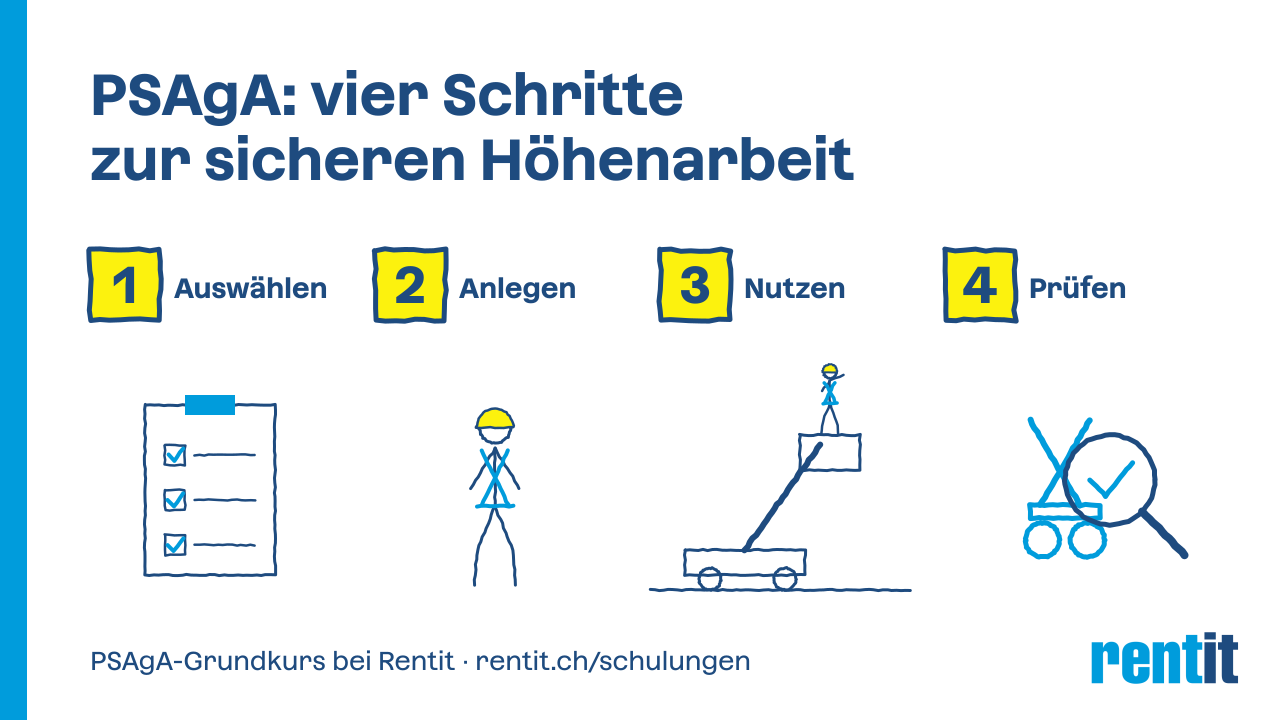
The basic course combines theory and practice. You will learn about the various safety systems and practise using them. This includes selecting the appropriate protective equipment, putting it on correctly, using it properly and checking it regularly. The trainers cover typical work scenarios: roofs, scaffolding, aerial work platforms and other work at height. At the end, you will receive a certificate. The training is based on SUVA guidelines.
Common pitfalls in everyday life
Many problems arise not because someone lacks equipment, but because small details get overlooked in everyday life. Here are a few examples that are also covered in the course:
- The harness is worn, but the lanyard is not clipped in.
- The equipment isn’t checked before every use, for example for visible damage.
- The harness isn’t fitted correctly because it hasn’t been adjusted properly.
- The anchor point is unsuitable or not intended for belaying.
Anyone familiar with such issues will recognise them more quickly, both in themselves and within the team. This is precisely why practice and regular training are more important than a one-off course that you’ve forgotten about years later.
Health and Safety at Work Act and lifting platforms: What are the rules regarding the work platform?
On an articulated or telescopic boom lift, the basket is your workplace at height. The type of safety equipment that is required and appropriate there depends on the type of machine and the task at hand. One thing is certain: anyone operating aerial work platforms should also have completed the IPAF operator training course. The two courses complement each other. The IPAF training shows you how to operate the machine safely, whilst the PPE training teaches you how to protect yourself in the basket and at the edge of the platform.
Conclusion: Safety is a matter of practice
Fall protection is not something you can simply tick off a list once and forget about. You need to become familiar with handling the equipment, and your knowledge needs to be refreshed regularly. The basic PPE for work at height course lays the foundations, and with the right equipment and a good induction, working at height will be much safer for you and your team.
Further links:
- PSAgA training at Rentit
- All training courses and dates
- IPAF training for aerial work platforms
- Hire articulated and telescopic aerial work platforms
Want to get yourself or your team ready for working at height? Sign up for a basic course or get advice on organising training at your premises: schulungen@rentit.ch or 24/7 via the hotline on 0800 55 88 89. Aiming high? Rentit.
Want to work safely? Rentit.
-
-
Silvio Hitz
- +41 (0) 71 222 22 44
- s.hitz@rentit.ch
Co-Geschäftsführer
Kundenberatung
Disposition
IPAF-Trainer

